
Hear the full interview
From 24:47 in Tuesday’s episode of Nick Luck Daily. Press play to start at the interview.
James Willoughby has welcomed the JRA’s latest innovations for the Japan Cup but warned that racing’s data is being “terribly used”.
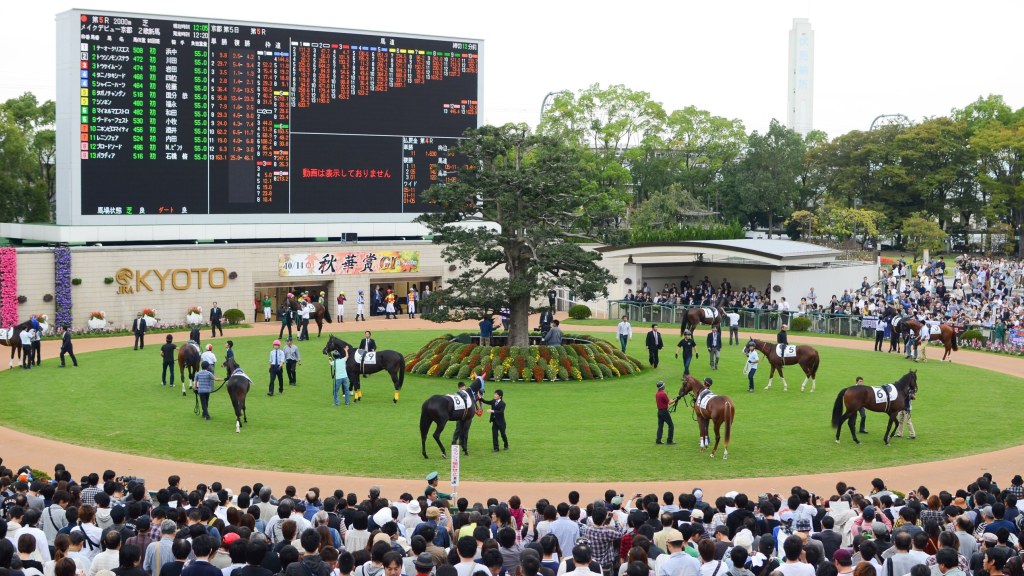
From Sunday’s Japan Cup, the JRA will use 18 cameras to track every runner, so viewers can follow any horse from the warm-up to the finish, and it will publish lap times for every runner in its Group 1 races the day after. “They have the financial muscle to do these innovations,” Willoughby told Tom Stanley. He does not think British TV coverage has moved on much since the golden days of Channel 4 Racing, “when executive producer Andrew Franklin would constantly innovate to present different shots of a race”.
I would argue that horse racing’s current data set is being terribly used.
James Willoughby
‘We’re getting absolutely nowhere near that’
Willoughby wants data used to explain how a race was run, not just who finished fastest. “It is not the point of measuring the sectional times of horses, live or otherwise, so that one can say that horse X finished the fastest or horse Y made up the most amount of ground from the two-furlong pole. We’ve been able to do that since 1873 just by watching,” he said. “What we need to do is to contextualise the run of the race so that endless arguments about whether horses were given too much to do or hit the front too soon can be answered objectively with the help of data. We’re getting absolutely nowhere near that.”
He is critical of how the numbers are reported. “Generally speaking, horse racing’s media are ill-equipped to make any kind of statistical inference,” he said. “Since I first entered the sport as a journalist 30 years ago, I think that we’ve gone backwards at a very fast rate in terms of our dissemination of data. We’ve got lots more of it, but the general level of analysis of it is a lot poorer.”
‘A popularity contest’
Willoughby is not a fan of the Cartier Awards, where Ombudsman was voted Horse of the Year. “Really they’re just horse personality of the year awards, aren’t they?” he said, calling them “a popularity contest”. He would have chosen Bow Echo, winner of the 2,000 Guineas and Sussex Stakes. “My point would be that Bow Echo was the best horse that looked through a bridle in 2026.”
He argued that Ombudsman’s two best performances were set up for him by his stablemate Devil’s Advocate. “Hopefully he’ll go and win the Japan Cup and prove that. But he had the races set up for him,” he said. He also rated Sun Goddess and Daryz as more remarkable racehorses than Ombudsman. He did praise one Cartier decision: the award of merit for Julian Richmond-Watson, who Willoughby said “has made an outstanding contribution to the sport” as an administrator and breeder. “He and his ilk are and have been the lifeblood of horse racing in this country.”
‘A very dangerous man’
As for Sunday, Willoughby thinks Ombudsman will be okay over a mile and a half but is “no certainty” to beat last year’s winner, Calandagan. “We saw again from the Mile Championship what a good trainer Francis-Henri Graffard is. He’ll have this Calandagan absolutely spot on for this race. This has been his target for ages,” he said. “And Graffard is a very dangerous man when he targets a race.”